
10 Signs you Need a New ERP System
Updated: Apr 16
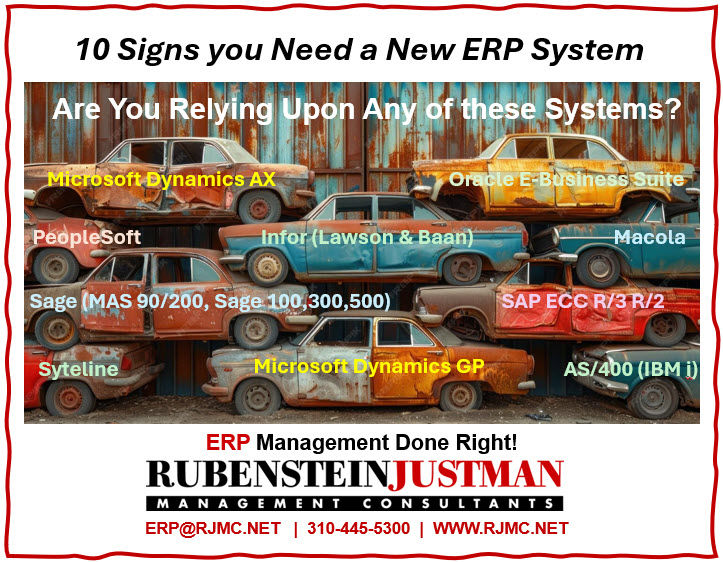
Rubenstein / Justman Management Consultants (RJMC) is frequently asked the simple question: “What are the signs that we need a new ERP system?” For many companies they intuitively know the answer to that question but are in a state of denial to avoid the perceived “pain” of migrating to a new, more user friendly and scalable solution. And of course there is always the concern over cost and implementation timeline. No question there is a risk that the project can accelerate out of control without experienced project management.
In summary, a new ERP system is likely necessary when existing software limits growth, relies on manual spreadsheets, or fails to provide real-time data, often resulting in poor user experience and high IT costs. Here is a list of the Top 10 signs that a new ERP system is probably in your future.
Top 10 Signs You Need a New ERP System
1. Reliance on Spreadsheets: You are managing critical business processes outside the ERP system, often using Excel, indicating manual workarounds. Although considered routine in your organization, reliance on static spreadsheets introduces what could be unnecessary preparation time and the probability for errors.
2. Inability to Scale: The current software cannot handle increased transaction volumes, additional users, or rapid business growth. Your current system was configured for your current state when you first implemented the solution. If the size and scope of your operations has changed you may be seeing new challenges that your system was not designed to handle.
3. Lack of Real-Time Data: Reporting takes hours or days, preventing quick decision-making and offering no immediate insights. Data drives business decisions. If you are investing considerable time and effort to present your data in a format that you can use you have probably out-lived that approach. Today there are real-time business reporting and analytics solutions that are delivered as dashboards and do not require hours or days of “prep” time and the data is accurate as of the moment it is viewed.
4. Data Silos & Disconnected Systems: Separate departments use different, non-integrated tools, requiring manual data entry and causing inconsistencies. If you have departments that have gone rogue and introduced standalone system solutions it is time to assess the effectiveness of this approach which could be costly and delivering inconsistent results.
5. Poor User Experience (UX): Employees struggle with outdated interfaces, leading to low adoption rates and productivity losses. Outside of work employees and prospective employees interact with platforms and solutions that present modern User Experiences. Expecting current and new employees to gain a level of proficiency using systems that operate with dated interfaces can be costly in a variety of ways.
6. No Mobile or Cloud Capabilities: The system is inaccessible from remote locations, hindering hybrid work environments and mobility. In today’s mobile environment we all expect that our business systems will be able to deliver for us regardless of our location. If you have to stage data or synchronize data bases for your users this is a sure sign that some level of modernization is needed.
7. Compliance & Regulatory Failures: The software cannot adapt to new industry regulations or tax requirements. This issue is more relevant to some industries than others but if a system is dated and no longer being supported, the inability to adapt to mandated regulatory changes is a sure sign that change may be warranted.
8. High Maintenance & IT Costs: You are spending a significant budget on maintaining old, on-premises technology and receiving minimal vendor support. As on-premise systems age and are no longer supported they may require more attention in the form of customizations which can be costly to implement and support. If your company is maintaining a team of programmers and / or analysts this is another sign that time is passing you by.
9. Lack of Functional Features: The current ERP fails to support modern business functions or lacks industry-specific requirements. This can be a sign whether you are relying upon an older system or even a newer system. Failure to properly evaluate your business needs prior to selecting and implementing your ERP can be a “Red Flag” that change is needed.
10. Frequent System Downtime: Slow performance and consistent, critical technical failures are hindering daily operations. Listen to your users. They are the first sign of a performance problem and usually do not hesitate to share their opinion!
RJMC is a trusted, independent advisor. We are experts in assessing systems and highlighting what works well and what needs improvement. Not all ERP options need to be costly or take years to implement. Let’s chat about your situation and we can provide you with a “best fit” budget and timeline to support a new Technology Roadmap.
~ LETS CHAT! (https://www.rjmc.net/erp-assessment)
📞 310-445-5300


Comments